Finanziato dall'Unione Europea NextGenerationEU
Ministero dell'Università e della Ricerca
Italiadomani Piano nazionale di ripresa e resilenza
Università di Messina
Università di Catania

Home
Italiano English

The Gallo-Italic linguistic minorities of Sicily


Traditionally, in the absence of direct historical sources, the settlers are considered to originate mainly from Monferrato, located between southern Piedmont and northern Liguria, but also in part from the Savona hinterland, and from the Pavia and Piacenza areas south of the Po River (cf. Petracco Sicardi 1969: 356-357). This does not exclude the possibility that other areas of northwestern Italy could have been involved in these migrations.

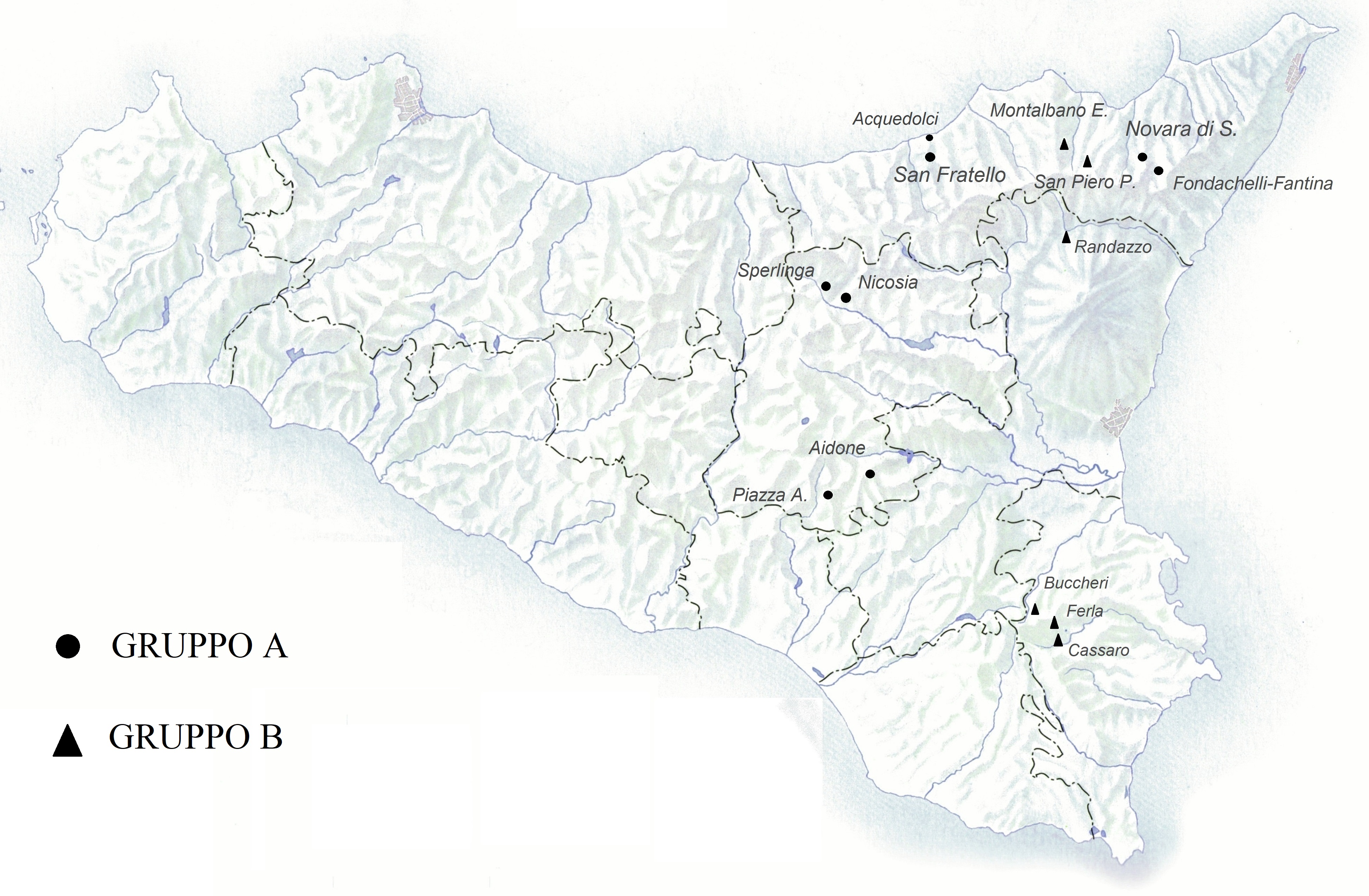
Today, Gallo-Italic varieties are spoken - to various degrees - in 14 localities. Only a subset of these (hereafter, “Group A”) are characterized by “dialectal bilingualism”. In these communities, the traditional Gallo-Italic dialect remains distinct (or did so until the early 2000s) from the local variety of Sicilian (= “local Sicilian”), which is defined as a form of Sicilian which presents Gallo-Italic elements (especially at the phonetic level). In the remaining localities (hereafter, “Group B”), on the other hand, “dialectal monolingualism” is practised: speakers use a single dialectal variety, which, depending on the community, ranges from a Sicilianized form of Gallo-Italic to a Gallo-Italicized form of Sicilian. Since around the 1970s, the repertoire of all Gallo-Italic communities has also included (regional) Italian.

Mappa Gruppi

In this project, we focus on Group A, where the traditional Gallo-Italic dialect is better preserved, in order to study traces of the centuries-old interplay between assimilation to and resistance against dialects of Sicilian.

These dialects can be further subdivided into 4 groups on the basis of their shared characteristics: 1) Sanfratellano, spoken in San Fratello and in the nearby Acquedolci; 2) Novarese, spoken in the hamlets and villages scattered across the (recently divided) municipalities of Novara di Sicilia and Fondachelli-Fantina; 3) Nicosiano and Sperlinghese, two very similar dialects spoken in Nicosia and Sperlinga, respectively, where the latter is the rustic variant of the former (Sperlinghese originated during the 16th-century repopulation of Sperlinga by families from Nicosia); 4) Aidonese and Piazzese, two dialects that have much in common from a structural point of view (Aidone originally developed out of Piazza Armerina).